

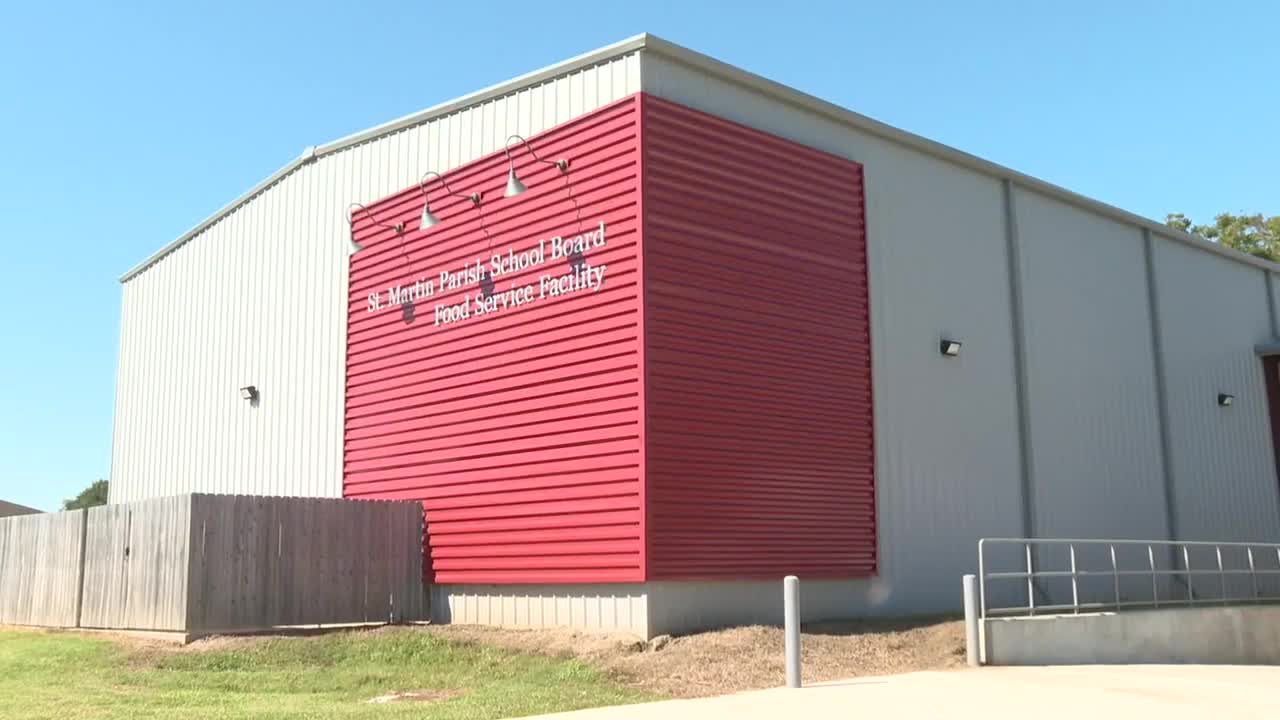


ST. MARTIN PARISH — The St. Martin Parish School Board has opened a new 10,000-square-foot food service warehouse in Breaux Bridge, a facility designed to streamline how nutritious meals reach students across the district each day.
Funded through a $2.3 million federal grant awarded during the coronavirus pandemic, the new hub replaces a much smaller facility in St. Martinville. The upgraded space now serves as a centralized location for storing ingredients and supplies used to prepare scratch-cooked meals for more than 6,500 students in the parish, including those in Lower St. Martin and Stevensville.
“Over here is our new facility as you can see,” said Reginald Hill, area food service manager, while showing the newly constructed warehouse. “It’s actually three times bigger than our old facility.”
Officials say the location in Breaux Bridge provides a logistical advantage, allowing the district to deliver meals and ingredients to schools across St. Martin Parish more efficiently.
Dr. Wanda Phillips, school nutritionist for the St. Martin Parish School Board, said the facility represents a major leap in their ability to serve students. “This state-of-the-art building allows us to house more supplies and foods and also enables us to get the supplies out faster being housed in Breaux Bridge,” she said.
The new facility also supports the district’s growing focus on fresh, local ingredients. Through a combination of grants—including the USDA’s Farm to School initiative, the Fresh Fruit and Vegetable Grant, and the MyPlate678 Grant—the school board is expanding its capacity to provide more balanced meals.
“It enables us to provide more fruits and vegetables in our menu on a daily basis,” Phillips said. “We provide on average five parts of the component, but we add an extra vegetable in the meals.”
Phillips added that the warehouse supports the district’s commitment to scratch cooking, which allows staff to better manage both cost and nutrition. “From the nutritional aspect we can control the amount of salt and sodium in our meals by cooking homemade scratch cooking, so the kids get four hot meals a week,” she explained.
Inside the new warehouse, the difference in scale is clear. “As you can see, we’re able to stack things three high. At the old facility we were only able to stack things one level high, so now we have more storage capacity on both sides here,” Hill said.
Beyond efficiency, Hill sees the facility as an investment in student well-being. “That is our ultimate goal—to make sure that each kid that comes through our serving line leaves with a memory,” Hill said.
Phillips echoed that sentiment, noting how the facility enables cafeteria teams to better serve their students each day. “We are very pleased having our new facilities to meet the needs of our students and provide them with a nutritious meal every day,” she said. “Our cafeteria staff members, managers, and technicians work really hard to provide a nourishing meal for our students.”
