

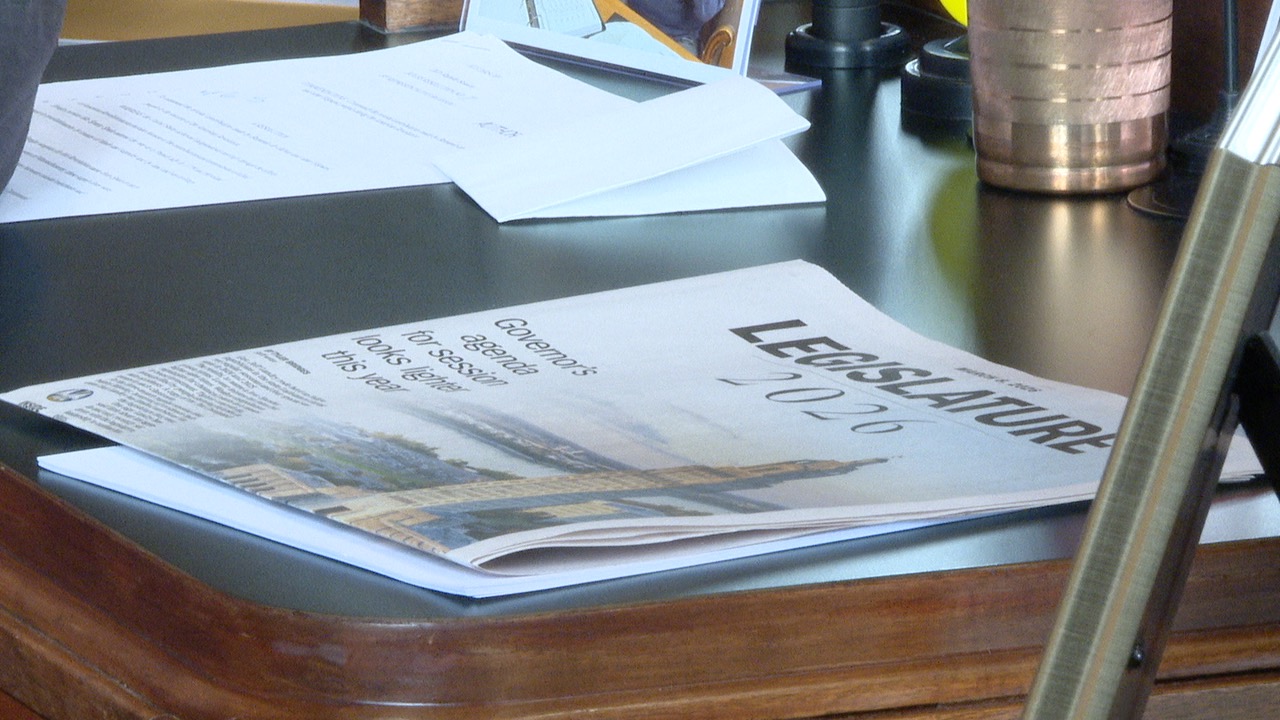

The 2026 Regular Session of the Louisiana Legislature opened today in Baton Rouge.
According to a release from the Legislature, lawmakers will tackle a variety of subjects including regulating Artificial Intelligence (AI), particularly when it comes to protecting children, regulation of carbon capture activities here in Louisiana, and proposals to increase investment in public safety and education.
“We have made such great strides in the first two years of this term, when you look at how far we have come in areas like tax reform and beginning to see insurance rates come down here in Louisiana,” said Speaker of the House Phillip DeVillier. “This year we want to build on those successes to encourage even more economic investment in our state and better prepare our workforce to take advantage of those opportunities.”
“As we carefully consider the proposed $47 billion state budget for next year, legislators want to fund the priorities that are important to Louisianans without committing our state to spending we can’t afford in the years ahead,” said Senate President Cameron Henry. “As we look ahead to next year when we want to bring down our state income tax rate even further, we’ll be looking to strengthen our long-term revenue sources so that whether it’s education, energy or public safety, we build revenue sources that our state can depend on going forward.
The House of Representatives welcomed four new members today. Chasity Martinez will serve District 60 in the parishes of Assumption and Iberville and has been named to the Education, Labor and Transportation committees. Ed Murray will serve District 97 in Orleans Parish and has been named to the Insurance, Municipal, and Transportation committees. Reese “Skip” Broussard will serve District 37 in the parishes of Calcasieu and Jefferson Davis and has been named to the Agriculture, Education and Transportation committees. Doyle Boudreaux will serve District 39 in Lafayette Parish and has been named to the Transportation, Administration of Criminal Justice and Retirement committees.
As of this morning, more than 1,360 bills have been filed by legislators, including the state budget, to be considered over an 85-day general legislative session.
To follow the legislative session in real time, the public can log into www.legis.la.gov [legis.la.gov] to search for bills and watch live streams of committee room and floor debates. The legislative mobile phone app LALEGE can be downloaded from the Apple Store or Google Play. This app includes a bill search and “find my legislator” function. Other key features include legislator profiles, Senate and House schedules and a visitor’s guide to the Capitol.
The 2026 Regular Legislative Session must adjourn no later than 6:00pm on Monday, June 1, 2026.
Here are Gov. Jeff Landry's opening remarks, as prepared for delivery. If you'd like to read the Democrats' response, scroll down past his speech.
Speaker Devillier,President Henry,Ladies and Gentlemen of the House and Senate,
Thank you for the privilege of addressing this Legislature.Few legislative bodies throughout this State’s history have worked harder than you to deliver generational change. Without your collective effort....
-our streets would not be safer,
-our infrastructure would not be improving,
-our taxes would not be lower,
-our insurance reforms would not be working,
-our budgetary discipline would not exist; and
-Our unprecedented economic growth would not be possible at this scale.
You and I were elected to do things differently.
-to reform systems that were no longer serving our people.
-to change the trajectory of an economy held back by tired policies,and to make unmistakably clear that Louisiana government works for the tax payers-
The taxpayers do not work for the government.
After 4 special sessions and 2 regular sessions, I stand beside you to say;
You kept those promises.
I believe that this Legislature and my Administration will be remembered for the promises we have kept.
Before I go further, we should pause to recognize that our beautiful and magnificent country is approaching a once in a generation milestone-the 250th anniversary of the Declaration of Independence on July 4th.This moment invites every American to reflect on the bold decisions that shaped its destiny.
Few states are more uniquely connected to America’s destiny than Louisiana and the Louisiana Purchase.For the Louisiana Purchase was not merely a real estate transaction-it was a defining act of American vision.It doubled the size of the country, secured our nation’s future, opened the door to westward expansion, and set the stage for America’s rise.
As part of America 250, President Trump has graciously granted Louisiana the extraordinary honor of hosting the original Louisiana Purchase documents-bringing home for the first time the very papers that created our great state and changed the course of our country’s history.
Our Secretary of State Nancy Landry is overseeing this historic display, and the opening is set for late April at the Old State Capitol.I invite each of you-and all the people of Louisiana-to take part in this generational moment.
This is more than an exhibit. It is a powerful opportunity for Louisiana to tell its story-to remind the nation that our state has always been central to America’s growth, ambition,and belief in the future.
In welcoming these documents, we are reminded that Louisiana was not an afterthought in the story of America. We were central to it. That bold decisions still matter. And that this great state remains a place where the future of freedom is shaped.As our citizens stand before these documents, they will not just see ink on parchment.
They will see proof that courage, vision, and faith in the future can change the course of history, just as we are doing today.
Take for instance Education, in just 2 short years, we have jumped 11 spots overall on the Nation’s Report Card. This is the largest one cycle leap in our state’s history and Louisiana’s highest overall ranking.
Our 4th Graders have displayed the largest gains in reading nationwide and Louisiana is the only state that students have fully recovered from the pandemic shutdown in math and reading.
Let us congratulate our BESE members and our Superintendent of Education Cade Brumley!Your passage of “Allowing Teachers to Teach” has eliminated burdensome bureaucracy,removed cell phones from the classroom, and has re-focused our educational mission on academics, re-affirming education not indoctrination.
You have staked the flag of morality by recognizing that the 10 Commandments are not a bad way to live your life.And Students who don’t read them, will likely have to read the criminal code.
I would like to thank our AG and her staff for the great work in defending our law.
I encourage you to strengthen the LA GATOR program helping families access the school that best suits their child.We must find a path so that the hard-earned money of parents, follows their child to the education of their choice.
Don't believe the media hype.
The statue allows us to provide opportunity while controlling cost.Members, this Spring the people of Louisiana will have the opportunity to make a smart, responsible, and long overdue investment in our teachers.
On the ballot, amendment 3 does two critical things.First, it pays down on the massive, long-standing debt in our teacher retirement system.Debt has restricted resources and hindered our support for teachers.
Second, it converts that progress into something teachers feel immediately: a permanent pay raise.
This amendment is not a temporary stipend. It is not a promise for another day. It is a permanent raise; earned, reliable, and responsibly funded.
Our teachers have stood by Louisiana through hurricanes, pandemics, and years of uncertainty.They stayed in the classroom when it would have been easier to leave.Passing Amendment 3 let’s our teachers know Louisiana stands by them.
With a yes vote we can strengthen retirement system, improve their take home pay, and do so without raising taxes.
I urge you to educate your constituents.Encourage them to Vote YES on Amendment 3.
I promised you that if we prioritized reforming our complex and burdensome tax code, we could measure the success.
Today we are seeing the fruits of our labor, as the upsurge of business interest and investment in our state reaches historic levels.By believing in me, you have given our economic development team and the ambassadors of this state the tools to generate worldwide interest in Louisiana.It’s no secret.As our great Secretary of Economic Development says, “Capital goes where capital is treated the best.”
And our policies of
-abolishing the franchise tax;
-lowering income taxes;
-tripling the standard deduction;
-eliminating special interest loopholes and exemptions; and
-drastically simplifying our tax code.
Are treating capital the best!
The Tax Foundation now ranks Louisiana as having one of the most competitive and lowest tax rates in the nation.
We should renew our commitment to further tax reform in our quest for total elimination of the state income tax.
When we took office, Louisiana was not lacking resources—only belief. Today, that belief has been restored.
Since we began, Louisiana has announced more than 124,000 new private‑sector jobs tied to billions of dollars in investment, diversifying our economy across energy, manufacturing, logistics, construction, and technology.
Opportunity is now reaching every region of our state.We started our term with a goal of $30 Billion, then last year moved it to $50 Billion, today we are fast approaching $100 Billion mark.There is a race to see which companies get us to that number and today we are joined by Ben Dell whose company, Commonwealth, is quickly competing to getting us there.
This momentum did not happen by accident.It happened because we cut taxes, restored order,reformed education, and partnered with the business community to fundamentally change how Louisiana competes.We chose growth over the status quo.Execution over excuses.
Early on, we reorganized and refocused LED.That reform sharpened our message and sent a clear signal across the country: Louisiana is serious.
And the proof is in the results. I want to thank Secretary Bourgeois and her team for their extraordinary work.
According to the U.S. Bureau of Labor Statistics the average wage in Louisiana has risen from $48,700 to $61,284 in six short years.New companies tracked by our Department of Economic Development are offering an average wage of $87,000 for the jobs being created today—more than 40 percent higher than our current average.This is how families move from dependence to independence.
But growth alone is not enough.
Economic success only works if our workforce is aligned with the jobs we are creating.
People often ask me why I am so passionate about this issue.
It is because I have seen firsthand what happens when it is not. In the mid‑1990s, as economic development director in St. Martin Parish, I watched Washington politics and a failure to diversify our economy devastate working families.When Congress passed NAFTA, the consequences were swift.Fruit of the Loom moved its textile machinery overseas after three decades of supporting middleclass families of Louisiana.Communities were hollowed out.Families were displaced.And the state was not prepared to reskill workers for new opportunity.The stability that NAFTA promised us and Latin America has not fully materialized.
Instead, millions who were supposed to find opportunities within their countries have sought them illegally in ours.
We learned a hard lesson: economic growth without workforce alignment leaves people behind.
Today, we face a different challenge—but one we should welcome.We have more jobs than people ready to fill them.Employers are ready.Projects are expanding.Opportunity is everywhere.But when a workforce system cannot move fast enough or operate at scale, growth slows—and opportunity slips away. But we must be honest about how we invest in our people.Today, Louisiana spends more than $300 million a year on TOPS, while only $6 million goes to students pursuing vocational and technical education.Yet only 30 percent of the new jobs we are creating require a four‑year degree -60 percent do not.
That mismatch does not service our citizens and slows growth.It is time to align our education and workforce dollars with economy -not ideology, -not habit, but results.
Our proposal increases the Promise Program funding to expand access to community and technical colleges that train students for in-demand, high-paying jobs.
While fully funding TOPS once again.This is not about choosing one path over another.It is about respecting every path that leads to work and opportunity.
That’s why we are supporting President Trump's initiative to eliminate bureaucracy and emphasize high-paying, high-demand jobs.
Through Louisiana Talent Accelerator, Secretary Schowen will streamline the workforce system, direct funding to training, prioritize credentials and measure outcomes—not paperwork.
I urge you to support Rep. Bamburg's bill to accelerate job placement in Louisiana.
Imagine a state where every job finds a worker and every worker finds a purpose.
Where a welder in Lake Charles, a coder in Baton Rouge, a logistics manager in Shreveport, and a line supervisor in Houma all find opportunity right here at home—right here in Louisiana.
All the economic growth in the world doesn’t matter if the people doing the work are too sick to benefit from it.That’s why we have focused on improving healthcare outcomes.
This year, Louisiana took a national lead by implementing the SNAP Healthy Food Waiver.For the first time, Food Stamp benefits are being used for nutritious food—not soft drinks and candy.That just makes sense.Better food choices mean better health and fewer chronic diseases like diabetes and heart disease.
We’ve also expanded the Carrot Initiative, which rewards families for buying fresh fruits and vegetables. Helping to stretch grocery dollars while encouraging healthier habits.
We’re also taking on one of the most heartbreaking public‑health crises in our state.Since 2018,overdose has been the leading cause of pregnancy‑associated deaths in Louisiana.That is simply unacceptable.Through Project M.O.M., we’ve partnered with hospitals across the state to improve screening, treatment, care coordination, and access to lifesaving medications—with a clear goal of reducing these deaths by 80 percent in three years.
Access to care matters. That’s why last year we raised Medicaid reimbursement rates to 85 percent.And it’s working.More doctors are opening clinics, more providers are accepting Medicaid patients,and more Louisianians—especially in rural areas—are getting care closer to home.
But access alone isn’t enough.We also reworked Medicaid quality metrics to focus on outcomes, not just spending—because results matter.And through the One Door transition, we’re aligning health and workforce programs so public assistance becomes a bridge to independence, not dependence.
Finally, this session we will seek to create an Office of Health and Nutrition—bringing food policy and chronic disease management together so we can take a smarter, more coordinated approach to improving health across Louisiana.
This is how we build a healthier, stronger Louisiana—by focusing on common sense, real results, and people, not programs.
One of the clearest examples of prevention done right is making sure the people coaching our kids know how to keep them safe.
Today, we are honored to have with us a true Louisiana legend—world‑renowned orthopedic surgeon Dr. James Andrews.Dr. Andrews was born and raised in Homer, Louisiana, where he played on the famous 1957 Iron Man football team that reached the state championship with just 15 players.That team so impressed LSU Coach Paul Dietzel that he offered every one of those young men a scholarship. Dr. Andrews went on to graduate from LSU Medical School, compete as an SEC pole‑vault champion, complete his residency at Tulane, and founded the Andrews Sports Medicine & Orthopedic Center.He revolutionized sports injury treatment and has performed career‑saving surgeries for some of the greatest athletes in the world—from Michael Jordan and Bo Jackson to Tom Brady, Peyton Manning, and Drew Brees. Dr. Andrews, would you please stand and be recognized in your home state. But Dr. Andrews didn’t stop at the operating room.He founded the Coach Safely Foundation to make sure youth coaches have the knowledge they need to protect the kids they coach.Senator Edmonds’ Coach Safely Act builds on that work by encouraging youth coaches to complete a short, online training—already proven successful in other states.
This common‑sense program teaches coaches how to recognize concussions,manage hydration, and keep kids safe and playing.It also reduces liability exposure for our municipalities,parishes, and parks and recreation departments.
Joining Dr. Andrews is Ryan Cross from FMOL Health.FMOL has agreed to fund this vital training for youth coaches in underserved areas of our state. Please give them a round of applause.
My mother coached youth sports for most of her adult life, and I know she would approve this effort.
Prevention, accountability,and common sense shouldn’t stop at our playing fields—they should guide our budget as well.
You have before you a responsible budget for Fiscal Year 2026–27—built on discipline,realism, and conservative money management.
A year ago, we committed to ending the old habit of funding ongoing government with one‑time money.This budget keeps that promise.It is built without temporary dollars and restores honesty to our finances. At $46.9 billion, this budget is smaller than last year’s $50 billion budget.It holds spending flat—because government should live by the same rules as the families we serve. That discipline has paid off. Louisiana now enters 2026 well within our constitutional debt limit.We have reduced total debt by $190 million and saved $117 million through refinancing.And the markets have noticed. Our bond ratings have improved across the rating agencies, confirming that Louisiana is regaining credibility. For too long, this state lived in a constant budget crisis. That era is over. From cutting $3 billion in spending in our first budget to holding spending flat while delivering the largest tax cut in state history,we are proving that fiscal responsibility and economic growth go hand in hand.
While our Fiscal Responsibility Program is complete, our commitment to efficiency is not.That is why we ask to strengthen the Inspector General’s Office—because protecting taxpayer dollars is not optional, it is essential. Fiscal responsibility is no longer a slogan in Louisiana. It's how we govern. Strong finances gives us credibility, but credibility must be felt at the kitchen table.For Louisiana families and businesses, that means fixing an insurance system that for far too long has failed them. For years our families were told that skyrocketing premiums and shrinking coverage were simply the cost of living in a hurricane prone state.But storms alone were not the problem.A broken system, driven by excessive litigation, delay, and a lack of accountability,was pushing rates higher and higher. That is why we worked together to pass the very first comprehensive insurance reform package in Louisiana history. For the first time we governed based on data not emotion.And let me tell you-the fight was real.
And the lobbying on emotion was at a peak. Last session, while you were debating House Bill 148, Sharon and I left Baton Rouge to run home to Broussard for dinner. (Off the cuff story here) You passed the bill. They stayed and premiums came down.That is what accountability looks like.
Together, we enacted insurance reforms that:
-reduced excessive litigation,
-prevents insurers from passing unjustified costs,
-restored common sense by limiting recovery for those operating illegally or at fault, and
-gave the Insurance Commissioner the authority to lower excessive rates.
And guess what? It worked: Because we used the data and ignored the emotion! By standing up for families and businesses, By restoring balance to the marketplace, we sent a clear message that Louisiana will no longer be bullied or broken by a system that works for everyone except the people paying for insurance.
Today a record number of companies have filed for rate decreases and given the reforms we have enacted, there is no excuse for them to go back up.
Take note—you have delivered results. I believe in good conscious that our Commissioner will work with us on behalf of the people of Louisiana to ensure that rates are reasonable. That is what reform looks like. That is what leadership requires. Lowering insurance costs protects families.But families also need safe, reliable roads and bridges to get to work, school, and home.That is why we are reforming and modernizing our Department of Transportation.
Our people sit in traffic, cross unsafe bridges, and wait years (sometimes decades) for projects that ever seem to move.The problem was not a lack of need.It was a system that moved too slowly, cost too much, and delivered too little.Together, we changed that.
Following your legislation last year, we reorganized the Department of Transportation and Development with a focus on speed, accountability, and results.
The new Office of Transformation and the Office of Project Delivery are streamlining design,cutting red tape, and moving projects faster (from conception to construction). And it is working.
Over the last 2 years we have invested more than $765 million through the Louisiana Transportation Infrastructure Fund to deliver new roads and bridges across the state.We are accelerating the replacement of 170 bridges, putting over $650 million to work on projects that sat idle for years.
Next month, we will break ground on one of the largest transportation projects in Louisiana history- the I-10 Calcasieu River Bridge, bringing long overdue relief to the people of Southwest Louisiana.
We also created a new Office of Highway Construction focused on the 4,000 miles of rural roads that don’t receive federal funding (the roads you hear the most about from your constituents).As a result, we are delivering 62 bridge replacements simultaneously across the state.
We are thinking long term also.That is why we are requesting the creation of a State Infrastructure Bank (SIB), a conservative, revolving financing tool that allows us to stretch dollars further, leverage federal programs without surrendering control, and deliver more projects without raising taxes. This is not rhetoric. It is about reliability and safety. We are finally building a transportation system that moves at the speed of Louisiana’s economy and delivers the results our people deserve. Finally, the nagging debate over inspection stickers has lingered for years.Finally, technology is helping us find a better way.
The traditional inspection sticker process is annoying, inconvenient, and serves little value to the safety of our roads and to the state agencies that interact with our motorists. A QR code sticker, for only $6, placed by you upon your vehicle, besides being cheaper than waiting in line to pay $10, is capable of providing instant information to law enforcement about ownership, year, make, model, and eventually insurance coverage information. I believe it is time to retire the inspection sticker! Do you? Retiring the inspection sticker is about one simple idea:government should work for the people, not waste their time or money.
And that same principle must apply beyond our roads—it must apply in our courtrooms as well. I have often said that the criminal justice system is a three‑legged stool—law enforcement,prosecutors, and judges. If even one leg is weak, the entire system collapses under the weight of the responsibility it carries. That system failed yet again, and Jacob Carter became a victim of that failure. Jacob was from Washington State, where he owned a famous bagel shop. He came to New Orleans with his partner to enjoy our culture and our city. Instead, in January of 2024, Jacob Carter was robbed, gunned down, and killed in the French Quarter. Jacob was a son.A brother.A friend.He was beloved and his family is here with us today. I ask them to stand and be recognized. Here is the plain truth: Jacob Carter’s murder was preventable. His killer was a juvenile already known to the system—arrested with guns and drugs, then released under electronic monitoring.He missed more than 400 required check‑ins.400!During that same period, the monitoring contract expired—without the judge or the district attorney knowing or caring.On the night Jacob was killed, the juvenile was not being monitored at all. When Jacob’s family demanded answers, they filed complaints against the judges responsible. Those complaints were dismissed—without explanation. That is not justice.That is not accountability.That is a system protecting itself—and it cost an innocent man his life. Judges hold enormous power.They are not social workers with gavels.They are the final gatekeepers of public safety.And when judges treat ankle monitoring like a suggestion, let contracts lapse, and ignore check‑ins,they are not “mistaken”—they are incompetent.And incompetence has no place on the bench. And make no mistake—this failure harms the juvenile too.When the system refuses to enforce boundaries or consequences, it does not rehabilitate. it abandons! Let me be clear about the cost.Jacob Carter is dead.His family is shattered.And the juvenile—who could have been held accountable earlier— will now spend much of his life behind bars.Two lives destroyed because responsibility was ignored.That is not justice.That is negligence masquerading as mercy. Last year, the people of Louisiana voted for judicial reform.They were not confused.They were not misled.They knew something was broken.Now is time to deliver—because this tragedy will be relived again. This is not new.After Hurricane Katrina, this Legislature—at the urging of Governor Blanco—recognized that the Orleans Parish court system was outdated and unsustainable.The Legislature acted, consolidated, reformed the system.But those reforms have been undone. Today, the consequences are undeniable. Today, the state spends more than twice as much on the Orleans Parish court system as it does in our largest parish.And unlike every other parish, we foot 100% of the bill. My budget supports a functioning judiciary, and through Troop NOLA we remain committed to public safety.But New Orleans’ financial crisis confirms what we already know: this system is broken,and it is time to right‑size it. I get that New Orleans is special.And the City is important to Louisiana.But being special does not mean being exempt from accountability— or entitled to an outsized portion of the tax dollars.
Accountability in the criminal justice system must hold judges to the highest standards,ensuring that those whose actions or inactions perpetuate systemic problems are dealt with.I strongly urge this Legislature to implement rigorous judicial reform, as justice delayed, denied, or neglected is no justice at all. My message is simple and sincere. Louisiana families are not asking for favors.They are asking for a fair shot and a government that respects their work, their time, and their trust.They get up early.They work hard, Everything that I have talked about here today-jobs, workforce, insurance, transportation, fiscal discipline, public safety, all comes down to one question:
Are our citizens lives improved because we showed up, too? Last year, near the end of a tough session, one of your colleagues questioned a decision I made, and I explained it this way: A man wanted to paint his house,(sprucing up for the 4th of July, like we do. So he called the only painter in town, (he lived in a small town) The painter told him he was booked all week but could do the job over the weekend if the homeowner would agree to cut his grass for him.The man refused. Coincidentally, the man’s neighbor needed his house painted, too and called the same painter who offered to work on the paint job over the weekend if the neighbor would cut his grass. The neighbor agreed. The deal worked out.The painter painted the neighbor’s house while the neighbor cut the painter’s grass. The lesson is simple, the man willing to cooperate got his house painted. Great things happen when we work together and reciprocate duties with one another.We can make our own demands and achieve nothing, or we can work together and achieve anything and everything. That is why each of you have on your desk a T-shirt saying, "Let's paint houses together."
Because -when a parent drives to work on a safer road
-when a family or a small business owner can afford insurance
-when a worker finds a job that finally rewards their skillset
None of these things occur by accident. They happen because:
-we have shown up and
-we have worked together.
May we continue to paint this great house together.
May we continue to choose action over excuses.
May we continue to create results over rhetoric.
May we continue to employ courage over comfort.
And if we do that, there really is no limit to what Louisiana can become.
God bless Louisiana, and God bless the great people we are honored to serve.
Here's what we received from the Democratic National Committee:
Today, Louisiana Governor Jeff Landry will deliver his State of the State address, where he will try to spin his abysmal record of higher costs and less health care for Louisianans.
Thanks to Donald Trump and Jeff Landry, Louisiana has rarely been worse off: working families are on track to lose over $1,300 [democrats.us2.list-manage.com] per year due to Trump’s Big Ugly Bill and failed economic policies, over 330,000 [democrats.us2.list-manage.com] Louisianans are set to lose their health care, while thousands more face skyrocketing premiums. The average Louisiana family will see a $926 [democrats.us2.list-manage.com] (208%) increase in premium payments without enhanced tax credits.
By nearly every measure, Donald Trump and Jeff Landry have proven to be a staggering failure of leadership.
DNC Chair Ken Martin released the following statement:
“As Jeff Landry delivers his State of the State address today, the reality for families across Louisiana is grim: Costs are climbing for essentials like gas and electricity, Louisianans are losing their jobs, and health care is becoming even more expensive and unattainable. As Landry attempts to gaslight working families and paper over his failures, Democrats won’t stop fighting to hold him accountable for making life more unaffordable for Louisianans.”
Jeff Landry’s real state of Louisiana, by the numbers
Costs:
- Louisiana working families have already lost $291 [democrats.us2.list-manage.com] in higher costs due to Trump’s inflation.
- Louisiana families will lose an additional $1,060 each year from Trump and Republicans’ Big Ugly Bill and Trump’s reckless tariffs.
Health Care:
- Louisiana’s 276,294 [democrats.us2.list-manage.com] ACA marketplace enrollees are seeing their health care costs skyrocket because Donald Trump refused to extend enhanced ACA tax credits.
- Because of Trump’s Big Ugly Bill and Republicans’ refusal to extend enhanced ACA tax credits, 330,000 [democrats.us2.list-manage.com] Louisianans could lose their health care entirely.
- The average Louisiana family will see a $926 [democrats.us2.list-manage.com] (208%) increase in premium payments without enhanced tax credits.
Food Assistance:
- Trump’s SNAP cuts will cause 406,000 Louisiana families to lose some or all of their benefits.
