



LAFAYETTE PARISH — Researchers at the University of Louisiana at Lafayette say a study involving live oak trees on campus may have uncovered carbon measurements lower than any previously documented by scientists worldwide, offering new insight into how climate change could be affecting plant life over time.
Student researcher Izamary Lara said the project initially felt intimidating because, unlike classroom labs with expected outcomes, the team did not know what they would find.
“As an undergrad, the first initial reaction that I felt was probably scared because you do all these labs in your class and you know what the result is going to be,” Lara said.
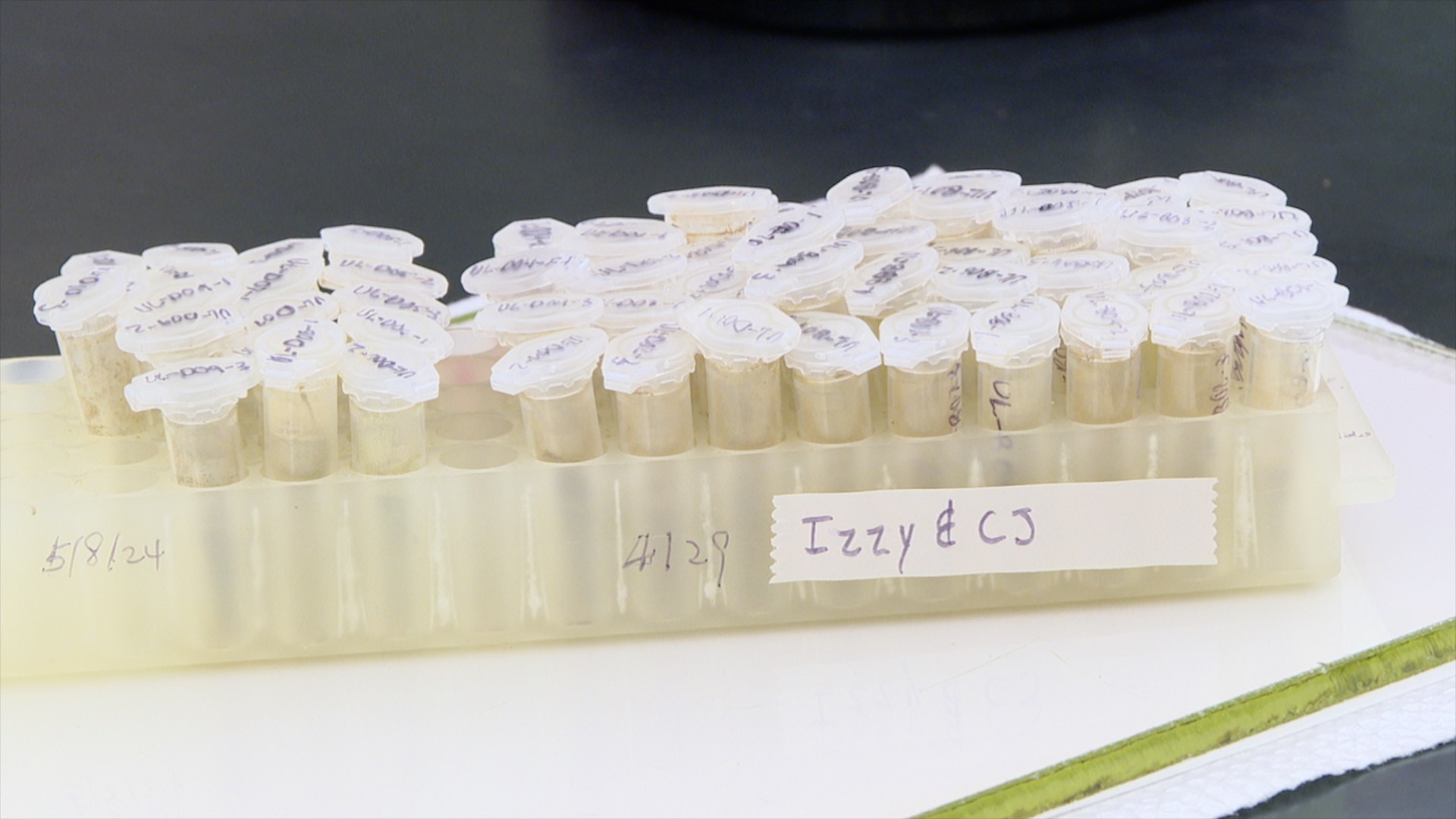
Lara and her research partner worked alongside faculty in UL Lafayette’s School of Geosciences to study live oak trees on campus and analyze how changing carbon dioxide levels may be altering plant chemistry.
Brian Schubert, professor and director of the School of Geosciences, said the project began as what the team believed would be a straightforward study.
“It was kind of a basic kind of a study. We thought we knew what we were going to get when we did it. It was a pretty safe kind of study. We've measured a lot of leaves throughout the years, but we just didn't realize how fast the atmosphere is changing,” Schubert said.
Through testing, Lara and Schubert said they found the live oak trees contained carbon levels lower than any scientists had previously recorded worldwide.
Lara said the findings highlight how carbon dioxide levels have shifted over time and why scientists continue studying those changes.
“With how much CO2 levels have changed in those time periods, it's important to see how those levels are gradually increasing and what it is affecting,” Lara said.
Lara and Schubert said the findings may suggest that rising carbon dioxide levels are chemically changing plants. Scientists have long used plants to help measure stable isotopes and study environmental conditions across different periods in Earth’s history.
Schubert said the data reveals how quickly environmental changes may be occurring.
“From that, we can see these trends through time, and it's pretty staggering when you start to look at these numbers just how quickly things have changed,” Schubert said.
Lara and Schubert said understanding why these changes are happening could help scientists better track how carbon dioxide influences both modern climate conditions and long-term environmental changes.
“While you're able to kind of correlate them to these carbon dioxide levels, you're able to see how human effect can actually affect the environment around us. And while we live safely in our houses, we are still affected by the environment that we live in every day,” Lara said.
This story was reported by a journalist and has been converted to this platform with the assistance of AI. Our editorial team verifies all reporting on all platforms for fairness and accuracy.
