

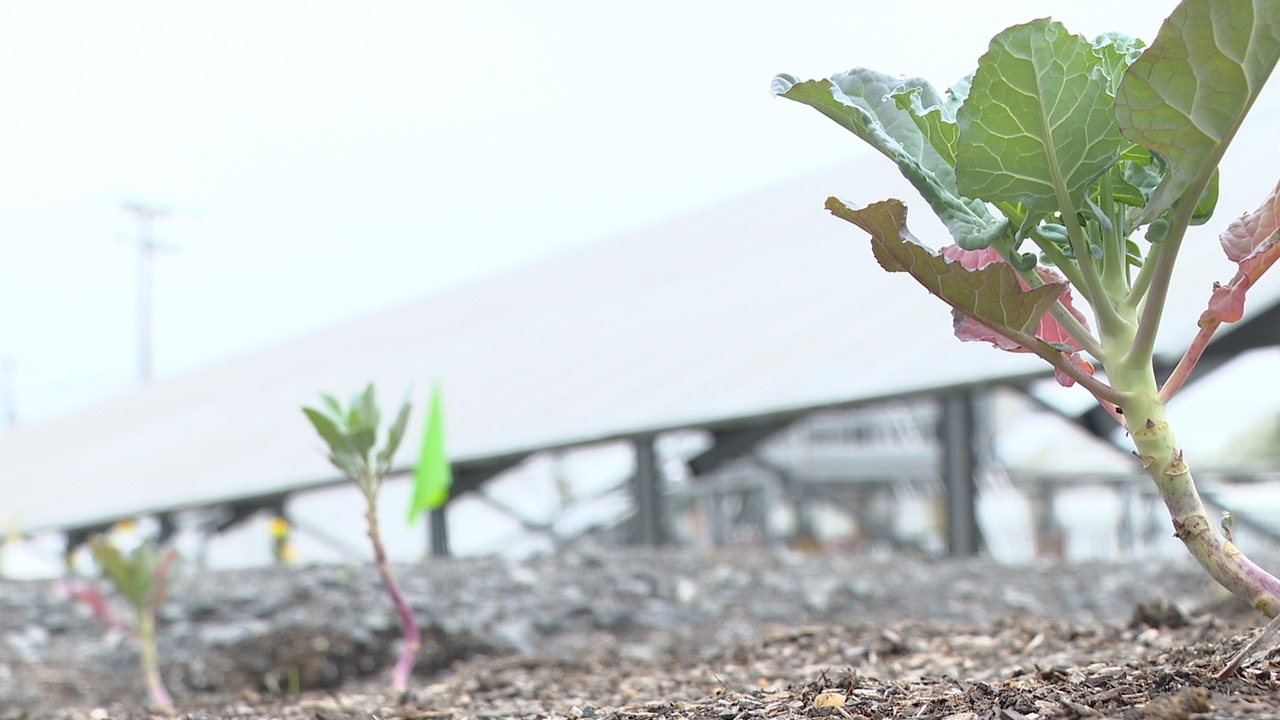


LAFAYETTE, La. — Solar panels are becoming an increasingly familiar sight across Acadiana, but researchers at UL Lafayette’s Louisiana Solar Energy Lab (LaSEL) are testing whether crops and clean energy can grow side by side through a new approach called agrivoltaics.
“Agrivoltaics is basically any agricultural commodity under solar panels,” said Dr. Caitlin deNux, one of the researchers leading the initiative.
Preliminary data from LaSEL suggests that growing plants beneath solar panels does not negatively impact their development. “The way in which plants can make food, their height, their leaf width are the same under partial shade and full sun,” deNux explained.
The shade provided by the solar panels also increases soil moisture and creates a cooler, more humid microclimate — conditions favored by both plants and solar cells. “By providing a cooler underside to the panel cells or the solar cells, you have a potential for more energy efficiency. So your plants do better because there's less heat stress and the panels do really well, too,” deNux said.
Researchers say agrivoltaics addresses sustainability concerns both environmentally, by reducing the need for irrigation, and financially, by lessening the burden on farmers’ budgets.
deNux added that the solar panels themselves are built to withstand severe weather, offering another layer of resilience. “These types of panels are able to withstand hurricane winds, right? So there's a chance that your crops could be protected within the panels themselves,” she said.
While full sun exposure still increases overall plant yield, the research aims to ease concerns about solar farming, including possible environmental impacts. “With preliminary data at least, we haven't found any heavy metals that are concerning – so that's a win! They don't produce loud sounds, they don't lower property values,” deNux noted.
She believes agrivoltaics could help farmers create a more profitable and sustainable future. “I think we have so much promise of this becoming something that could be an option for people and to help people, and especially farmers who are going through a tough time right now,” deNux said.
Researchers say their findings could help Louisiana farmers optimize limited land resources while adapting to a changing climate.
This story was reported by a journalist and has been converted to this platform with the assistance of AI. Our editorial team verifies all reporting on all platforms for fairness and accuracy.
