




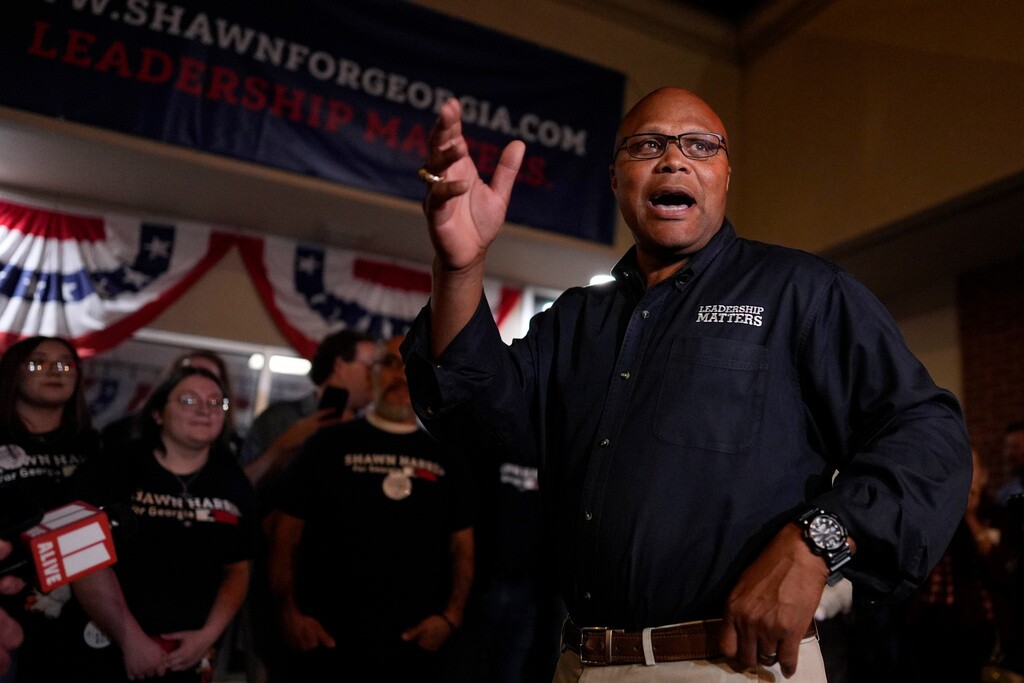
Democrat Shawn Harris and Republican Clay Fuller advanced to an April 7 runoff for Marjorie Taylor Greene’s former U.S. House seat in Georgia after no candidate won a majority in Tuesday’s special election.
President Donald Trump in February endorsed Fuller, a district attorney who prosecutes crimes in four counties, to succeed Greene.
Fuller has called Trump’s endorsement “rocket fuel” for his candidacy, but it did not boost him to a majority of the vote in a 14-candidate field that included nine Republicans, three Democrats, a Libertarian and an independent. All the candidates ran together regardless of party, with the top two moving on to the runoff.
Harris, a cattle farmer and retired brigadier general, is likely to face an uphill battle to win a majority in the heavily Republican district. Nevertheless, Democrats are likely to boast of his first-round showing as a further success in a period when they have focused on strong performances in special elections. Harris has promised moderation and a focus on the district’s problems, contrasting himself with Greene’s bomb-throwing style.
The winner will serve out the remaining months of Greene’s term. A Republican win in northwest Georgia’s 14th Congressional district would bolster the party’s majority in the House. The district stretches from suburban Atlanta to the Tennessee state line.
Fuller was a White House fellow in the first Trump administration and is a lieutenant colonel in the Georgia Air National Guard. He finished fourth in the 2020 Republican primary that Greene won before becoming a district attorney. Fuller had set an outright win as his goal for Tuesday’s vote.
RELATED NEWS | Talarico triumphs, Cornyn–Paxton runoff caps chaotic start to midterms
This round of voting is only the first step in an elections marathon in the Georgia district. Republicans and Democrats seeking a full two-year term are set for a May 19 party primary, and possibly a June 16 party runoff, before advancing to the general election in November.
Last week, 10 Republicans and Harris qualified to run in November's election for a full two-year term. That includes Fuller, as well as Colton Moore, a former state senator and favorite of far-right activists who drew attention for a vociferous attack on Trump’s prosecution in Georgia for alleged election interference.
For some, support for Trump hasn't wavered. Presley Stover of Dallas, Georgia, voted for Fuller. She said she doesn't agree with the president on everything, but supports him on the whole.
“I think as of right now, he’s doing a great job," she said. “He’s definitely helping us a lot more than Biden did. I mean, as of now, they’re not the best, but you’re not gonna change anything overnight.”
Some Republicans, though, were unaffected by Trump's nod.
“God, no. That's not going to sway me one way or the other,” said Brendon O’Laughlin of Dallas, noting he voted for Brian Stover, a Republican from his area. O’Laughlin said he was looking for a change in style from Greene.
Those who backed Democrats said they were repelled by Trump and eager to reduce his power.
“There just needs to be checks and balances and I don't think we have many of those right now," said Matthew Wisniewski, a Dallas resident who voted for Harris.
But voters on a whole in the district embraced Greene’s hard-right campaign in 2020, when she parachuted into the district after aborting a campaign in a more closely contested district closer to Atlanta.
Greene was one of the most well-known members of Congress until she left in January. She remained loyal to Trump after he lost to Democrat Joe Biden, promoting Trump’s falsehoods about a stolen election. When Trump ran again in 2024, she toured the country with him and spoke at his rallies while wearing a red “Make America Great Again” hat.
But Greene began clashing with Trump last year after he and other Republicans pushed back against her running for U.S. Senate or governor. Greene criticized Trump’s foreign policy and his reluctance to release documents involving the Jeffrey Epstein case. The president eventually had enough, saying he would support a primary challenge against her. Greene announced a week later that she would resign.
Returning another Republican to Congress would bolster the party's narrow majority in the House. Republicans currently control 218 House seats to Democrats’ 214.
MORE ON ELECTIONS | Could a Democrat flip Georgia’s most Republican district after Greene’s exit?
